
Home Electrical Safety Tips Every Homeowner Should Know | CT Electrical
Home Electrical Safety Tips Every Homeowner Should Know
By CT Electrical Installations Ltd | Dudley & the West Midlands | 5 min read
Electricity powers everything we rely on — but it's also one of the leading causes of accidental house fires in the UK. The good news is that most electrical hazards are entirely preventable. Here's what our team of qualified electricians in the Dudley area want every homeowner to know.
1. Know Your Consumer Unit — and Check It Regularly
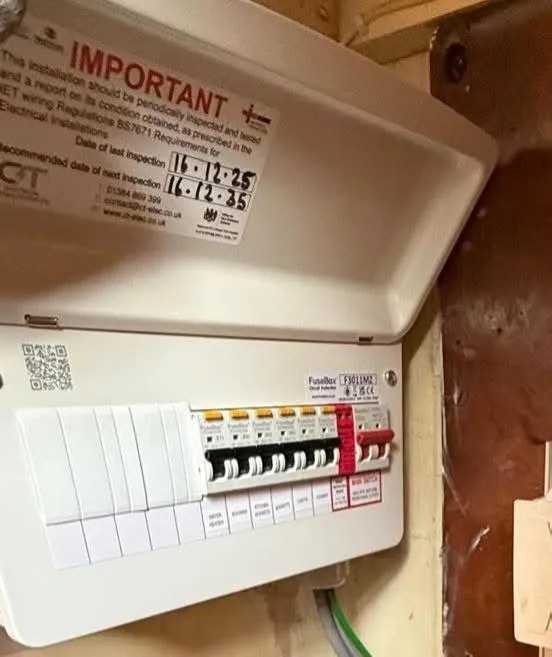
Your consumer unit (commonly called a fuse box) is the heart of your home's electrical system. It distributes power around the property and contains the protection devices that cut the supply if something goes wrong. If your consumer unit is more than 25 years old — particularly if it still contains old-style rewirable fuses rather than modern circuit breakers — it may no longer meet current safety standards.
Modern consumer units should contain both MCBs (Miniature Circuit Breakers) and RCDs (Residual Current Devices). MCBs protect individual circuits from overloading, while RCDs provide life-saving protection against electric shock and earth faults. Under the current wiring regulations (BS 7671:2018 + Amendment 2:2022), all socket circuits and all lighting circuits in domestic properties must have 30mA RCD protection.
What to look for in a modern consumer unit:
Clearly labelled circuits (lighting, sockets, cooker, etc.)
RCD protection covering both socket and lighting circuits
No signs of burning, scorch marks, or unusual smells
Switches that move freely and click firmly into position
A metal enclosure (required under current regulations for fire protection)
⚠️ When to act immediately: If your consumer unit has a plastic enclosure, contains old ceramic fuses, or shows any signs of heat damage, contact a qualified electrician. These are not cosmetic issues — they're genuine fire and shock risks.
2. Recognise the Warning Signs of Faulty Wiring
Many electrical faults give off warning signs well before they become dangerous. Learning to spot them early could prevent a serious incident. Here's what to watch out for around your home:
Flickering or dimming lights — often a sign of a loose connection or an overloaded circuit
Circuit breakers that trip repeatedly — indicates a persistent fault, not just a one-off overload
Warm, discoloured, or buzzing sockets — serious signs of arcing or a poor connection
A burning smell near outlets or switches — act on this immediately; switch off at the mains and call an electrician
Sparks when plugging in appliances — occasional small sparks can be normal, but frequent or large sparks are not
Shocks or tingles from switches and appliances — however minor, these should never be ignored
Old or brittle wiring — rubber-insulated cables from pre-1970s installations can become dangerously fragile over time
3. Don't Overload Your Sockets
Socket overloading is one of the most common causes of electrical fires in UK homes, and it's entirely avoidable. Every socket outlet is designed to handle a maximum load — typically 13 amps per socket. When too many appliances draw power through the same outlet via an adaptor or extension lead, the wiring can overheat.
Plug-in cube adaptors (the kind that turn one socket into three or four) are particularly problematic because they concentrate multiple high-draw appliances into a single unfused connection. If you need more sockets, the right solution is to have additional outlets installed by a qualified electrician — not to stack adaptors.
Appliances that draw the most power:
Electric kettles and toasters — typically 2,000–3,000W
Tumble dryers and washing machines — 2,000–2,500W
Electric heaters and fan heaters — 1,000–3,000W
Microwave ovens — 700–1,200W
Vacuum cleaners — 700–2,500W
A good rule of thumb: never run more than one high-draw appliance from the same socket or extension lead at the same time, and always use extension leads with built-in surge protection and a fused plug.
4. Test Your RCDs Regularly
An RCD that has never been tested might not trip when you actually need it to — mechanical components can seize over time. Most RCD and consumer unit manufacturers recommend pressing the test button every three months as good practice, though this isn't a legal obligation for homeowners.
Testing takes less than a minute. There should be a small test button on each RCD in your consumer unit (usually labelled 'T' or 'TEST'). Press it firmly — the RCD should trip immediately, cutting power to the circuits it protects. Press the reset button to restore power. If it doesn't trip, or won't reset, call a qualified electrician.
💡 Good habit to build: Many people align RCD tests with the clocks changing twice a year and pick one other date through the year. Add it to your calendar so it doesn't get overlooked.
5. Electrical Safety in the Kitchen and Bathroom
Water and electricity are a dangerous combination, and the kitchen and bathroom carry the highest risk of electrical incidents in the home. UK wiring regulations (BS 7671) define specific zones in bathrooms that restrict where different types of electrical equipment can be installed — which is exactly why bathroom electrical work should only ever be carried out by a qualified electrician.
Bathroom zones and IP ratings:
Bathrooms are divided into three zones under BS 7671 Section 701, each with minimum IP (Ingress Protection) ratings for any electrical equipment installed:
Zone 0 — inside the bath tub or shower basin itself. Equipment must be rated at least IP67 and must be low voltage (max 12V SELV)
Zone 1 — directly above the bath or shower up to 2.25m from floor level. Equipment must be rated at least IP65 and must be RCD protected
Zone 2 — extending 0.6m beyond the boundary of Zone 1 up to 2.25m high. Equipment must be rated at least IP44
Standard socket outlets are not permitted anywhere within bathroom zones. The only exception is shaver supply units, which must comply with BS EN 61558-2-5 and can only be installed in Zone 2 where they are unlikely to receive direct spray. All bathroom circuits must have 30mA RCD protection.
Kitchen: Keep appliances away from the sink and never touch switches or appliances with wet hands. If you notice condensation building up around sockets or inside fittings near cooking areas, have it investigated. Extractor fans must be adequately rated for the environment and properly wired.
6. Get a Periodic Electrical Inspection
An Electrical Installation Condition Report (EICR) — sometimes called a periodic inspection — is a thorough assessment of your home's fixed electrical installation carried out by a qualified electrician. It checks the condition of wiring, earthing and bonding, the consumer unit, and all accessories across the property.
For owner-occupied homes, an EICR is recommended every 10 years. For rented properties, landlords in England are legally required to have one carried out at least every 5 years under the Electrical Safety Standards in the Private Rented Sector (England) Regulations 2020. A copy must be provided to tenants before they move in, and to existing tenants within 28 days of a new inspection. Failure to comply can result in civil penalties of up to £40,000.
When buying a property — particularly an older one — commissioning an EICR before exchange gives you a clear picture of the electrical condition and any remedial work required.
An EICR classifies observations using codes: C1 (danger present — requires immediate action), C2 (potentially dangerous — urgent remedial action required), and C3 (improvement recommended, but not a regulatory fail). Any C1 or C2 observations must be remedied to bring the installation up to standard, typically within 28 days.
🏠 Moving into a new home? Even if a recent EICR is provided by the seller, it's worth commissioning your own independent assessment — particularly for older properties where previous owners may have carried out DIY electrical work that doesn't meet current regulations.
7. Always Use a Qualified, Registered Electrician
In England, electrical installation work in dwellings is covered by Part P of the Building Regulations. This means most fixed electrical work — adding new circuits, replacing a consumer unit, installing outdoor wiring, or working in kitchens and bathrooms — must be carried out by a Part P registered competent person or notified to local authority building control.
Using an unregistered person to carry out electrical work isn't just a safety risk — it can also cause serious problems when you come to sell, as you'll need to demonstrate the work was completed correctly and to the required standard.
Look for electricians registered with a government-approved competent persons scheme such as NICEIC. These organisations assess members' technical competence and allow them to self-certify their work, issuing the required certificates and notifying building control on your behalf.
Frequently Asked Questions
How often should a home electrical installation be inspected? For owner-occupied homes, an EICR is recommended every 10 years. For rented properties, landlords are legally required to have one carried out at least every 5 years under the Electrical Safety Standards in the Private Rented Sector (England) Regulations 2020, and must provide a copy to tenants within 28 days.
What are the signs of faulty wiring in a home? Key warning signs include flickering lights, circuit breakers that trip frequently, burning smells near outlets or switches, discoloured or warm sockets, and buzzing or crackling from electrical fittings. Any of these should be investigated promptly by a qualified electrician.
Is it safe to do my own electrical work at home? Minor tasks like changing a light bulb or replacing a plug are fine. However, any fixed wiring work — new circuits, consumer unit changes, outdoor wiring, or work in kitchens and bathrooms — must be carried out or certified by a qualified electrician registered under Part P of the Building Regulations.
What does an RCD do and why do I need one? A Residual Current Device monitors the flow of electricity through a circuit and disconnects the supply within milliseconds if it detects a fault — such as a person receiving an electric shock. Under current regulations, all socket circuits and lighting circuits in domestic properties must be protected by a 30mA RCD.
Can I use an extension lead permanently instead of having more sockets fitted? This isn't recommended, particularly for high-draw appliances. Extension leads are intended for temporary use. Permanent reliance on them — especially overloaded ones — increases fire risk. Having additional sockets installed by a qualified electrician is the safe, code-compliant solution.
Concerned about your home's electrics? CT Electrical Installations cover Dudley and across the West Midlands. Get in touch for an EICR, consumer unit upgrade, or just a professional opinion — we're here to help.